
Literary Pathways for Microtension
Microtension is one of the most important elements of fiction, but few writers have even heard about it. It’s tension at the word, phrase, and paragraph level, which elevates the most ordinary writing into powerful, gripping prose.
Upon realizing that no books have been written on this crucial topic, I set out to collate all I have learned on the subject. I heard of the term about ten years ago at Donald Maass’s Breakout Novel workshop in Oregon. Ever since, I’ve been writing and teaching about microtension. And recently I taught a few master classes with small groups, helping them learn the various microtension pathways and infuse their pages with this “sticky stuff.”
I cover a full chapter on literary devices, because I’ve found they are the most important and powerful pathway for microtension. Here are just some of the many literary devices you can use. I’m going to share an excerpt from my book, but there is so much more writers need to know about microtension and how to wield it in their fiction. I hope you will see why so many writers are super excited about this book and what they’re learning from it (just read the reviews on Amazon!).
Other Literary Devices
Here are some brief lines that demonstrate some other common (and not-so-common) literary devices. You don’t have to memorize all these terms, but become familiar with what they are and how they work in a sentence so you can use them in appropriate ways for strong effect.
Adnomination: Repetition of words with the same root. The difference lies in one sound or letter. In that scene from my novel Intended for Harm in which Simon throws Joey off the roof, moments later his stepmother shows up:
“Where’s Joey?” she asked.
Simon sucked in a breath, started to answer. “He’s around—”
“Here, Mommy.”
Simon jerked up his head, watched Joey run over to Rachel on his unshattered legs, put his small unbroken bony arms around her, his unsmashed head leaning against her waist, his unbloodied hands on her hair.
The use of these “un” words—emphasizing that none of Joey’s bones broke in the fall—add weight via microtension to the shocking and unbelievable reality Simon is witnessing.
Merism: This is when people or objects are described by listing traits. Here’s a brief usage in Leave the World Behind by Rumaan Alam. The author is also using motif by choosing words related to the beach they are heading to.
They wound into the empty parking lot (it was early) and paid five dollars to a khaki-uniformed teen who seemed himself made of sand— golden curls, freckles, browned skin, teeth like little shells.
Metonym: A figure of speech that uses a word or term to replace or represent another closely related word or term. From Lexicon by Max Barry:
Tom had wandered over to the magazine rack, where a man in a red-checked snow hat was staring suspiciously at shrink-wrapped women.
The shrink-wrapped women stand for women posed in men’s voyeuristic magazines, not literally women in shrink wrap!—notice also the bit of alliteration that adds a lyrical quality. Try saying shrink-wrapped women five times fast!
Allusion: Alluding to something familiar in comparison. This, frommy novel Conundrum:
Survival was paramount. If she remained, death was certain—if not literal, then emotional. She’d weighed choices over and over until they became too heavy to hold any longer. She had a fleeting opportunity, had to grab it with both hands or she would miss the golden ring; it would fly past her, irretrievable, and she would languish with longing, regret, the bitterness ebbing away at her until nothing remained.
The allusion to grabbing a gold ring evokes the 19th-century feature of some carousel mechanisms: a dispenser that presented rings (usually iron) on a horizontal arm as the mechanical horses passed. One of the rings was brass; grabbing it earned the rider a prize—commonly a free ride. It grew into a metaphor (figurative) for grabbing hold of an opportunity.
Personification: This is a popular microtension technique, one I love to use, especially when writing fantasy—though it’s easy to insert in any genre. Attributing human characteristics to inanimate objects, even just an adjective or verb here and there, can create wonderful sticky prose. Phrases like “the snarling wind” or “the stubborn door” may seem insignificant, but they aren’t. Once you start looking for them in great fiction, you’ll see them everywhere. Here are some examples from Lexicon (Barry’s novel is brimming over with these):
The driver’s window was half-cranked, letting in furious air.
His bindings loosened; he brought forward his arms against the protest of his muscles and rubbed his wrists.
They trudged through blackness and snow until Wil could no longer feel anything. His nerves retreated somewhere deep inside, where there was still warmth.
When the car exited the garage into bright sunshine, she closed her eyes. Somewhere in the snarl of streets, she fell asleep. [Notice the nice alliteration, too.]
I’m very fond of zeugmas. A zeugma is when you apply a single word or phrase to additional words but in creative ways. Here are some lines from Intended for Harm that use this literary device (also note the use of epiphora, with a grouping of verbs ending with fied, and adjectives ending in able, to give a lyrical feel):
She went into the bathroom, brushed her hair and washed her face, came out, checked her purse. She took out her prescription bottles; she wouldn’t need those happy pills anymore. Pills that mollified and simplified and verified and nullified.
She deposited her key ring on the little shelf. She wouldn’t need them anymore—those keys that opened doors and started engines and kept her world running on empty … She would not be able to lie to him that easily, but she would this one time, to stave off the inevitable, the unbearable, the unthinkable.
There are many more literary stylistic devices, though, and covering all of them would require volumes. Take the time to explore these and see if you might add them to your microtension toolbox to use at just the right moments in your scenes.
I hope this little foretaste gets you excited to read more!
New Release! Masterful Microtension
“I just finished studying Masterful Microtension. It’s simply breathtaking. An uninterrupted epiphany from page 1 until the end. For me, as an aspiring mystery and thriller writer, this is simply gold, something everybody who wants to engage any kind of reader should learn and master. What I can say … this is just absolutely brilliant and unique.” —Andrea Paglino
“I’ve purchased almost every craft book that C. S. Lakin has published, but I think Masterful Microtension is the most powerful thing she’s written yet. She defines the purpose of microtension as evoking a tiny spark of surprise. The thing that gives us that ‘Wait, what?’ moment. Just having a name for that is so helpful, then she goes on to show exactly how to create that moment in your manuscript. Amazing! Thank you!” —Marilyn T. Parker, author of The Struggle for Love
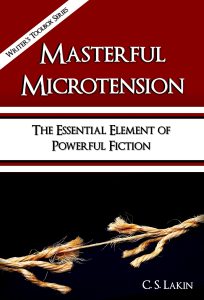 Learn how to masterfully craft microtension in your fiction. Microtension is the subtle but powerful element operating beneath the surface of a scene. It is created through contradiction, emotional friction, subtext, charged description, symbolism, and imaginative wordsmithing. When microtension is present, readers feel compelled to keep reading. When it’s missing, even well-plotted stories can feel flat.
Few writers have ever been taught about microtension in fiction and why it’s so important. And you’ll be hard-pressed to find any books, courses, videos, or articles on it. Yet … without it, your fiction can fall flat.
In Masterful Microtension: The Essential Element of Powerful Fiction, you’ll study how skilled fiction writers create tension at the micro level using masterful techniques such as word pairings, literary devices, motifs, and polarities.
Most books on fiction writing focus on structure, character arcs, and dramatic conflict. While those elements are crucial to a great story, they only address the big-picture elements. Microtension works at the word level, shaping the emotional energy between narrative, actions, and thoughts.
Regardless of what genre you write, Mastering Microtension will magnificently transform your prose. If you want to elevate your fiction from competent to compelling, from readable to unforgettable, microtension is the key.
Get your copy (ebook or paperback) on Amazon or any other outlet online!
Featured Photo by Jakob Owens on Unsplash